Find more funding
There are many other organisations who may be offering funding that will help you, and our handy funding search tool brings them all together.

Abertay University is to lead research into a €6.8 million European project tackling harmful industrial pollutants as part of major strand of the Horizon Europe-funded EmerGO project.
The four-year EmerGO project brings together 18 partners from 10 countries to develop new approaches for tackling pollutants in wastewater generated during food production and cleaning processes. Backed by €6.8 million in funding through the Horizon Europe programme, the initiative will focus on contaminants including microplastics and nanoplastics, per- and polyfluoroalkyl substances (PFAS), endocrine disruptors, antibiotic residues, and disinfectants and detergents.
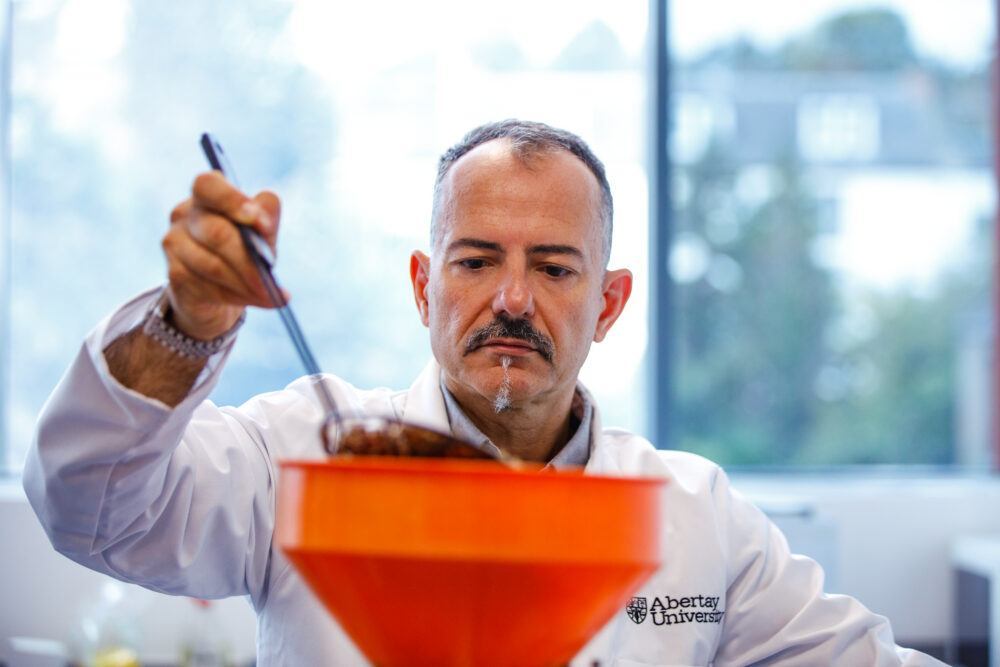
Abertay leads a key strand of the project that will identify where persistent and emerging pollutants occur across the food and drink sector, how they behave, and which pose the greatest risks to the environment and human health. The findings will guide the development of advanced technologies to detect, treat and reduce pollution. Delivering this work is Abertay’s research team, led by Professor Alberto Fiore and including Dr Kimberley Bennett, Dr Boon Chu Seang and Dr Slim Blidi.

Professor Alberto Fiore, Professor of Food Chemistry & Technology, said:
“Persistent and emerging pollutants present a growing environmental challenge, particularly where conventional wastewater treatment processes are not designed to detect or remove them effectively.
“Through EmerGO, Abertay will help establish a robust evidence base on the pollutants entering water systems from food production. This knowledge is essential for developing innovative technologies that can reduce environmental impacts, support healthier ecosystems and help industry adopt more sustainable practices.”
As part of the project, Abertay researchers will pull together existing data on contaminant inputs to wastewater from the food and drink industry and their sources, then create a comprehensive baseline database of persistent and emerging pollutants. They will also design monitoring campaigns at three representative industrial facilities and develop a framework to identify the pollutants posing the greatest risks to the environment and human health.
Dr Kimberley Bennett, Reader in Comparative Physiology, said:
“Understanding which pollutants are entering wastewater and the wider environment from the food and drink sector will help us identify effective ways to prevent those controllable releases. This is vital if we are to protect ecosystems and human health. By building a clearer picture of which of these contaminants are present in food industry wastewater and which processes they come from we can help ensure that new treatment approaches target the contaminants of greatest concern.”

The wider project will combine AI-enabled sensing and treatment technologies to detect pollutants, remove them from wastewater, and enable water reuse and resource recovery. The solutions will be tested in meat, fruit juice and confectionery plants, with targets to cut pollutant levels by 40 to 80 per cent, remove more than 75 per cent of contaminants, reuse over half of treated water and recover more than 30 per cent of salts and reagents.
EmerGO will also examine the “cocktail effect”, in which exposure to multiple pollutants can intensify harm to ecosystems and human health, to inform more effective treatment strategies. The findings are expected to inform future European industrial pollution policy and give consumers clearer information about the environmental effects of food production.
Coordinated by the Spanish technology centre Eurecat, EmerGO brings together research organisations, technology companies, industry partners and public engagement bodies from across Europe and South Korea.
Read more about the project on the EmerGO website.
There are many other organisations who may be offering funding that will help you, and our handy funding search tool brings them all together.