Find more funding
There are many other organisations who may be offering funding that will help you, and our handy funding search tool brings them all together.

World Peatlands Day celebrated with record restoration figures in Scotland

On the day (Tuesday 2 June) the world celebrates the importance of healthy peatlands, the annual Peatland ACTION review has revealed that 15,448 hectares of peatland restoration – the equivalent of nearly 30,000 football pitches – was achieved in Scotland through the partnership in 2025. This total is over 3,000ha above the Scottish Government’s Programme for Government target for 2025/26.
Healthy peatlands are carbon sinks, estimated to hold the equivalent of 140 years’ worth of the country’s total annual greenhouse gas emissions. Scotland has around 2million hectares of them, but they are currently one of our largest degraded ecosystems making them a contributor to climate change if we don’t restore them.
Supported by £35.5 million of Scottish Government funding, the resulting 15,448 hectares of restoration is a record annual figure and was made up of the following contributions from the Peatland ACTION Partnership:
Cabinet Secretary for Climate Action and Rural Affairs Gillian Martin said:
“As we celebrate World Peatlands Day, I am pleased to report Scotland’s Peatland ACTION Partnership has put 15,448 hectares of degraded peatlands on the road to recovery. We have again exceeded our annual Programme for Government commitment.
“Restoring our peatlands creates quality jobs and economic opportunities in rural areas as well as reducing emissions, mitigating risks of flooding and wildfires, improving water quality, increasing biodiversity, and making our landscapes more resilient to the damaging effects of climate change.
“As well as our record delivery this year we have published our Peatland Action Five Year Partnership Plan and new Climate Change Plan which represent significant milestones for the programme. The Peatland ACTION Annual Review 2025–26 highlights the progress we are making on delivering against these key documents.
“I thank all of our partners for their sustained efforts and tenacity in delivering another landmark year.”
As well as the restoration work, a new Peatland Training Fund was launched last year, allowing over 100 people to build new skills. The Peatland Internship Programme supported six organisations to take on full-time interns for up to six months, giving them the experience and skill to move into the peatland restoration sector.
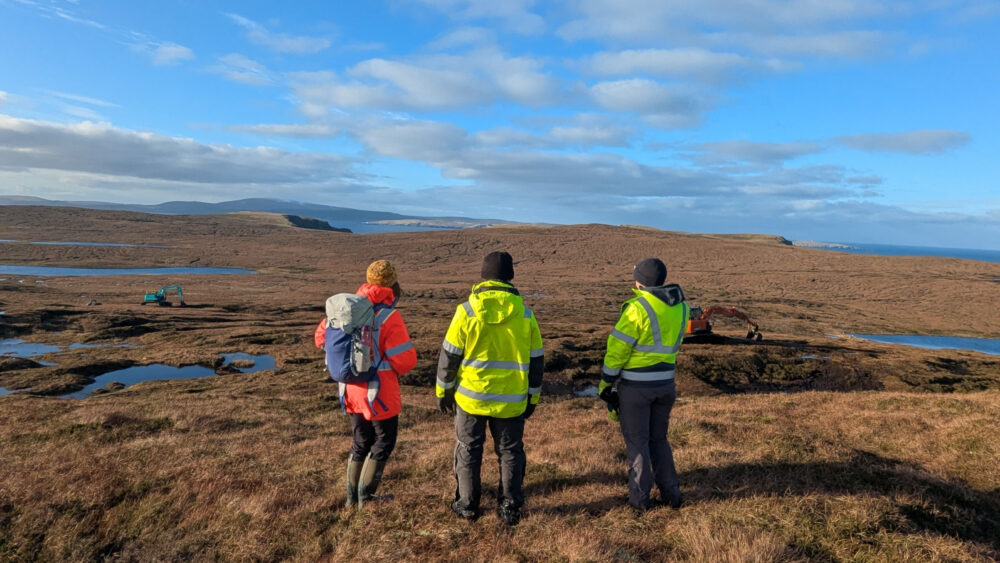
Manouk Wilkinson, a Peatland ACTION Project Officer for the Cairngorms National Park Authority, explains how her love of nature saw her enter the sector through the training fund:
“I can’t believe how lucky I have been. I took a leap of faith from being an English teacher to becoming a peatland restoration practitioner and it has worked out well for me. I like working with nature and understanding what’s going on around you. I was a mountain guide during my weekends, and I started doing peat depths and feasibility studies for peatland agents. I really enjoyed that and I got a lot of work quickly, so I decided to leave the security of teaching and look for work in the peatlands.
“The Peatland ACTION traineeships became available last year, and I successfully applied for the one with Shetland Amenity Trust. I was shown how to work with mapping, site visits, community engagement and junior rangers – it was a brilliant five months in which I learned a lot.
“Peatland restoration in Shetland is challenging; they have a short growing season and there’s a lot of wind and water erosion. That came in handy when I moved to my current role with the Cairngorms National Park Authority, where there are similar conditions. My new job is as a Peatland ACTION Project Officer, thanks to the skills I learned in Shetland.
“It makes sense to me to do something that is such a simple intervention to tackle CO2 emissions. It’s an easy win in terms of climate change. When it comes to biodiversity loss, I’ve seen some amazing restoration sites with hen harriers flying overhead, sphagnum moss carpets, golden plovers and red throated divers enjoying it. It’s just wonderful to see a healthy functioning peatland.
“I love the combination of being in the field as well as being in the office and creating the maps and doing the communications side of things. We’ll be looking at degraded peatland sites and making plans with managers to restore that peat. We’ll be scoping, looking at features, and agreeing a project area and a restoration plan. Once we get the project funded, we’ll be able to get contractors in to do the work, and the results of that restoration will count toward next year’s annual restoration figures for the Scottish Government.”
There are many other organisations who may be offering funding that will help you, and our handy funding search tool brings them all together.